On Saturday, August 18th, Andrea and I spent the
day at the Hermitage, and even staying until 9:00 p.m. when it closes was
insufficient time to see it all.
But that was alright.
Spending that much time walking through any museum is surely tiring, but when the great majority of text is in an unfamiliar language, the
fatigue becomes even greater, faster.
Andrea discriminately saw what she set out to see, and I
trailed after her, wandering through the rooms and down the halls with mouth
mostly agape and camera clicking.
While the vast art collections are definitely impressive, it
was the buildings themselves that impressed me the most. Books have been
written about the Russian kings and queens and their architects and designers.
But it was the physical and unknown, probably unappreciated individual craftsmanship that went into
constructing such a huge palace for Russian royalty – and which remains to this
day through all the historic turmoil – that I found most spectacular.
And to think of the manual, daily labor required to keep up
such a residence for the tsars, empresses, their families and court is utterly
mind boggling.
The State
Hermitage Museum
(as it is officially called) is actually comprised of several buildings: 1) The
Winter Palace (which comprises the largest portion and the section most familiar from photographs of its green exterior); 2) The Small Hermitage; 3)
The New Hermitage; 4) The Large (or Old) Hermitage; 5) and the Hermitage
Theatre and Winter Palace of Peter the Great. They are all connected.
I didn’t photograph them, but one of the things that greatly
interested me (like the air conditioning system at St.
Isaac’s Cathedral the day before) were little gold, circular contraptions near
the floor. Andrea inquired with one of the museum staff for me, and they are
part of a now defunct internal hot water system that was used in washing the floors!
Kind of like those vacuum systems you sometimes see in modern homes, but more
appropriate for the time!
And speaking of the floors, the intricate parquetry is
different in every room and truly outstanding. And as I found in the grand
Italian palazzos we visited, the door and window hardware fascinated me. To
have that foundry contract just for the Winter Palace
would have earned a mint for an enterprising merchant.
Lastly, I want to make a comment about the display of the “modern”
art. The Hermitage is often heralded as a depository for Impressionism and the
movements that came after. And while the Gaugin, Matisse, Van Gogh and Picasso
collections singularly impressed me, I found it strange that these works and
the works of Degas, Renoir, Monet… were relegated to the third floor.
The walls are plain. The ceiling is low. The floor is
non-descript. It is a jarring disconnect from the pompous grandeur of the other
rooms on the first and second floors.
To me, it is the equivalent of putting these works in the
attic to be hidden like the odd relative you don’t want guests to suffer.
Perhaps they are there for a good reason. There may have been air conditioning,
but the windows were open, so I am not sure. Maybe the flat, fluorescent
lighting to better see the painting is the reason, or because they simply ran
out of display space below and will continue adding to the collection in what
appears to be ongoing, unused space up there.
Below are selected photos from our interesting day at the
Hermitage.
 |
| Dvortsovaya Square. To the left stands the Hermitage (not in photo.) On the far right is the old main headquarters of the Ministry of Defense. |
 |
| The Alexander Column. The angel on the top is also one of the famous icons of SPB. |
 |
| Front baroque exterior of Hermitage from the Palace Square (taken at the base of the Alexander Column.) Through the arches and under the building, you enter a long open courtyard with walkways and trees. Typically, a long line of museum visitors would queue up there, but we had virtually no wait on this beautiful, un-museum day (clever, huh?) |
 |
| The grand staircase leading up to the Grand Suite of ceremonial halls, designed by Rastrelli. |
 |
| Will checking out the grand staircase. |
 |
| First of the grand halls... |
 |
| Overlooking the Neva River and the Dvortsovaya Embankment. |
 |
| We miss our dog and cat. |
 |
| Here Cricket! Come on little girl! |
 |
| Rembrandt's Hall - a terrific collection of his work, as well as all the Northern artists. |
 |
| One of Andrea's all-time favorite paintings - The Prodigal Son Returns. This is the one she said that inspired her to finally love Rembrandt's work when she was here so many years ago. |
 |
| Typical window hardware. |
 |
| I was enthralled by the chandeliers, wall trim and ceilings in just about every room. |
 |
| Your typical room at the Hermitage...elaborate! |
 |
| The parquet floor in the Italian room. |
 |
| What I call the Italian Room, but the Hermitage calls the Leonardo da Vinci Hall (silly museum.) |
 |
| Andrea checking out this little Italian masterpiece. |
 |
| Will, Andrea and a statue by Michaelangelo. |
 |
| What I call the Spanish Room with immense skylights in the ceiling. There are actually three of these skylight rooms at the Hermitage. During the siege of Leningrad, the skylights shattered, and rain and snow came pouring in and piling up, damaging the rooms and remaining artwork. Thankfully, the Russians are amazing at restoration work, as evidenced by the work they did at Peterhof. |
 |
| Down what I call the Spanish Steps. |
 |
| Up the Spanish Steps. |
 |
| God buddies, forever! |
 |
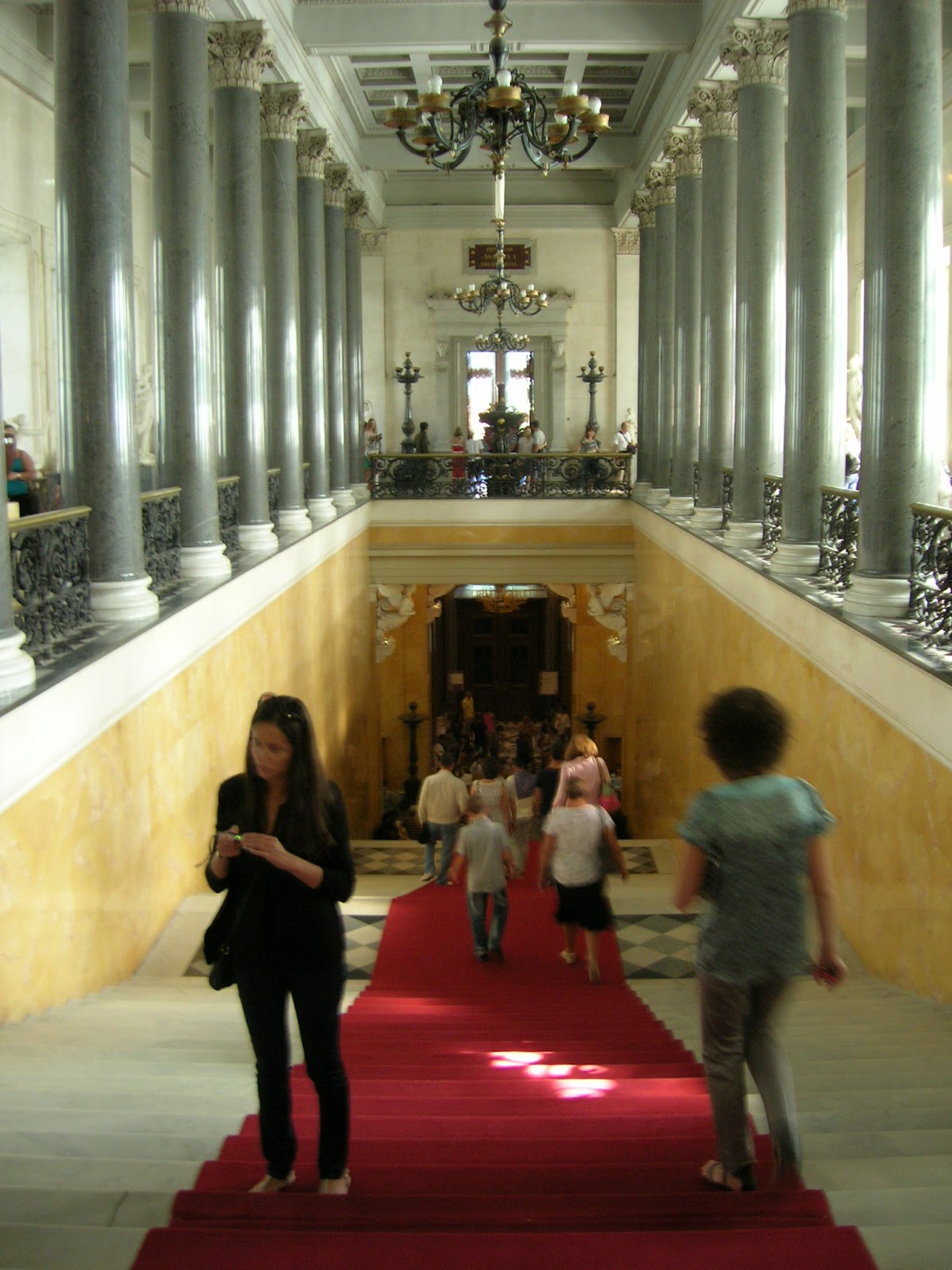
| Andrea helps a Russian family find their way. I call this my staircase (I spent a lot of time atop and below here) and my entrance (because there is a door that goes out to the Neva embankment, and I told Andrea that is the door I used when visiting my good buddy, the tsar.) |
 |
| Typical, plain old door at the Hermitage leading into... |
 |
| ...Pavilion Hall. This is an amazing space. There is a working peacock clock. The peacock is larger than I am. It is in a huge cage, and it's made from gold. To the right is the hanging garden. |
 |
| This garden is called hanging because it sits on the roof of what was the horse stable below. During royal times, it had fancy flowers, trees and shrubs. During the siege of Leningrad, the remaining staff grew vegetables and fruit to stay alive. |
 |
| The immense Throne Room. |
 |
| This long hall is full of portraits of military officers. It is punctuated by large canvases of field marshals and war heroes. The special display at the end is Alexander 1, the tsar who commanded the troops that defeated Napoleon in 1812. |
 |
| This is Armorial Hall. Huge. Gold. Silver. |
 |
| This is Peter the Great's Little Throne Room off Armorial Hall. |
 |
| The Malachite Room, where everything is wrought in malachite, except the fireplace screen. |
 |
| For Bill Gitlin, DDS - a bad photo of an 18th Century dental instrument used to keep open a patient's mouth. How do you say, "tooth ache" in Russian, Bill? |
 |
| From the third floor, you get a sense of the majesty of the rooms. |
 |
| And then on the third floor, you have these plain rooms. This room contained all Matisse paintings. |
 |
| This room held part of the Picasso collection. |